The 2008 Postville Raid:
Looking Back, What Have We Learned?
by Gregory Johnson
As part of America’s diversity, we have an opportunity to celebrate the cultures of the world. Each year, on May 5, millions of people in the United States, Mexico, and around the world observe Cinco de Mayo as a celebration of Mexican heritage and pride.
In 2008, in the small rural community of Postville, Iowa, the Cinco de Mayo Festivities almost coincided with the Jewish observance of Passover. This is significant in Postville because the town has a large population of Jewish and Latino members in the community in addition to the traditional Iowans found there. So, in 2008, the Jewish and Latino citizens in the city of Postville would have two reasons to reflect on and appreciate their respective heritage and cultures.
Although I am not of Jewish or Latino upbringing, as an American and world citizen I have enough cultural awareness and sensitivity to be familiar with these festivals. So, on 12 May 2008, while the dust of celebrations was settling, I was shocked and embarrassed to learn that our federal government conducted a surprise raid on the people and community of Postville, specifically targeting the primary employment and economic source of the community – a Kosher meat packing plant.
The awkwardness of descending upon a community of Jews and Latinos during a time of celebration is unfortunately reminiscent of world-wide anti-Semetic attacks on Jews during holidays. According to a report by The Israel Project, “Security in Israel will be stepped up over Passover, as is common during Jewish festivals when terrorist organizations often increase their efforts to perpetrate attacks on Israelis.” [source]
The U.S. Immigration and Customs Enforcement (ICE – a division of the Department of Homeland Security), the Justice Department, along with other agencies, without warning, descended upon Rubashkin Agriprocessors Inc., a Kosher slaughterhouse and meat packing plant. Given the scope of the raid, the number of agencies involved, and the severity of the action taken, one might have assumed the plant was engaged in illegal drug production, arms trade, selling of contaminated food, or some other act that threatened the lives of local citizens. However, none of this was true. The raid was a response to a reported immigration violation. It would ultimately be the raid itself that threatened the lives (or at least livelihood) of those in the local community.
The Postville situation very likely might have been calmly and effectively handled by means of a respectful investigation and routine enforcement operation through cooperatively working with business owners over a period of several months. Certainly this kind of approach could have achieved a more focused and desirable outcome. Such an approach could be compared to when a doctor uses surgery to remove just the cancerous tissue rather than amputate an entire limb; or tries to help heal an infected or injured area rather than cut it out.
However, instead of taking a surgical and gradual approach to correcting the immigration problem in Postville, the tactical strike against the community was so broad and devastating that it had the same outcome economically as if bombs had been randomly and carelessly dropped on the city. Almost 400 people were arrested and then held captive in a nearby fairground where normally cattle would be detained. The attack on the community was so severe that it impacted everyone, including the elderly, children, and other innocent bystanders. Some have suggested that the raid poorly addressed the needs of the families and children involved.
The situation was so disturbing that the American Civil Liberties Union (ACLU) got involved to ensure that the detainees did not have their rights abused. At one point, there were more people detained in Postville, Iowa by our government than those detained in Guantanamo. Yet these people were not terrorists, they were simply employees who were not authorized to work in the U.S.
Even a year later, Postville hadn’t recovered from the raid. Rental properties that were at 100% capacity before the raid are now at 20% occupancy (an 80% decline). Prior to the raid, it was hard to find a home for sale in Postville. Today, 248 homes are for sale at 20% below their assessed value. There are only 750 homes in the entire city of Postville – that means that about 1/3 of the city’s homes are up for sale. More than 9 businesses in the community have shut down, and the local bakery, worth $350,000, is now being advertised to sell at $150,000. Agriprocessors previously employed 950 people. A year after the raid, only 300 work there.
Unfortunately, the raid on Postville has punished and harmed many more people than just a few hundred unauthorized workers. The raid harmed an entire community and an entire region – an area that reflects true American cultural diversity. According to some statistics, the regional pricing of agriculture (for Iowa) was negatively impacted when compared to surrounding states for current and prior year’s data.
It’s clear that communities shouldn’t be attacked by their own government in a way that harms everyone in the community. While we can’t change the past, we can look forward and insist that this kind of tragedy not be permitted to happen again.
We can also do our best to help build up and restore Postville in the same way we would assist a town devastated by a natural disaster.
* * *
About the Author. Gregory Johnson is the Director of the ResourcesForLife.com website. He is a technology support specialist and also works as a consumer advocacy consultant. In March of 2006, as a long-time vegetarian, Gregory visited the meat packing plant in Postville to observe their practices and became one of the few vegetarians to speak out in defense of the meat packing plant. He wrote an article about his experience that became the topic of an interview on National Public Radio. The article is available here: https://resourcesforlife.com/docs/item46
Additional Resources. Below are some additional resources about this issue.
- abUSedThePostvilleRaid.com – A website featuring video footage and interviews from the raid.
- Des Moines Register, “Critics recall last year’s raid at Agriprocessors, plan protest,” 11 May 2009
- Forbes Magazine, “Amid vigils, Iowa town pins hopes on sale of plant,” 11 May 2009
- Gazette Online, “Postville decimated by immigration raid one year ago,” 10 May 2009
- Iowa City Press Citizen, “Raid attacked whole community,” 15 May 2009, Page 7A
Comments and Negative Feedback. Below are selected comments that reflect the feedback generated from this story. Gregory Johnson provides a response.
- Bleeding Heart Liberals. “Bleeding heart liberals like Gregory Johnson support slave labor, which is essentially what Agriprocessors was, and human trafficking, which is how the people got their. Bleeding heart liberals like Gregory Johnson support Company Towns, crooked local politicians, and a morally offensive Catholic Church that should be stripped of tax exempt status while the priests and nuns involved should be thrown in the slammer. Bleeding heart liberals like Gregory Johnson want open borders. They don’t mind if companies pay “under the table” or even employ children. Who cares if some honest person has their identity stolen so that some disease ridden foreigner can work and get welfare?” SurrenderDorothy, 15 May 2009, via press-citizen.com
- Response: As you might imagine, it’s hard to present all my views and positions in about 500 words or less. In case it wasn’t clear from my article, I’m not in favor of slave labor, child labor, human trafficking, company towns, crooked politicians, morally offensive religious institutions, open borders, identity theft, or spreading diseases (as your post suggests). I think we need to have laws to prevent such things — and enforce the law. However, I’m simply suggesting that we look for more effective ways to equitably, equally, and humanely enforce the law. Does that seem reasonable? By the way, I don’t consider myself a “bleeding heart liberal.” I’m an independent who has supported a wide range of political and social leaders including conservatives such as Mike Huckabee.
Got What They Deserved. “The 400 workers were breaking the law and knew it. The management was breaking the law and knew it. The citizens knew they all were probably doing so. (Or are you suggesting otherwise?) If you don’t want to pay the time or the fine, don’t do the crime. True, it seems all meat-packing plants hire illegal workers, and we can’t be fair & bust all of them, but we can keep them all on their toes if we focus on the worst offenders, of which Agriprocessors was one. I have a little more pity for the town in general, but if you base your economy upon illegal activity, don’t be surprised if the rug is pulled out from under you, just be grateful you benefitted for as long as you did. The editorial might be more convincing if it focused upon a poorly-planned INS procedure (e.g. who takes care of the captives’ kids?) or argued that no natives want to do this grisly work at these wages…. If you support yourselves through criminal behavior – whether you are the illegal worker, business owner setting up and catering to law breakers, or the landlords renting to law breakers – be prepared for the fall when it happens. No sympathy here. Everyone of these people knew what was going on. The plant managers, the workers, the townspeople, landlords, shopowners, etc….. My tax dollars have paid enough for having to arrest and deport these people as well as paying for ther anchor babies and for their illegal alien children to go to school. No more of my tax dollars to dig ths town out of the mess it got itself into. They walked a fine line – reaping the benefits of something that was legally, morally and ethically wrong – now let them pay the piper on their own. The immigrationlaws are not immoral. The people who break them are.” – MatthewA, 15 May 2009, via press-citizen.com
- Response: This is definitely a difficult and complex issue. We do need to have laws and enforce them, yet we need to look for more effective ways to equitably, equally, and humanely enforce the law. ~ Gregory
* * *
Document History. This article was originally written by Gregory Johnson and published on 11 May 2009. A shorter version appeared in the Iowa City Press Citizen on 15 May 2009 (page 7A). It is being re-posted and slightly updated for the 2-year anniversary of the federal raid on the Postville, Iowa Agriprocessors Rubashkin meat packing plant.
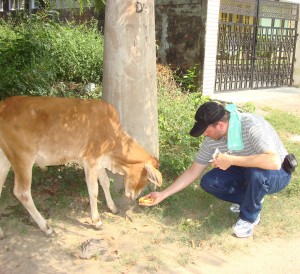
Photo Credit. During a visit to India in 2008, Gregory Johnson shown in the photo at the top of this page giving prasad (blessed food) to one of the local cows that roam freely in neighborhood streets.