Summary. Like many website, the Download.com website managed by cnet has advertisements. However, because the website is dedicated to software downloads, the advertising is strategically placed and deliberately misleading.
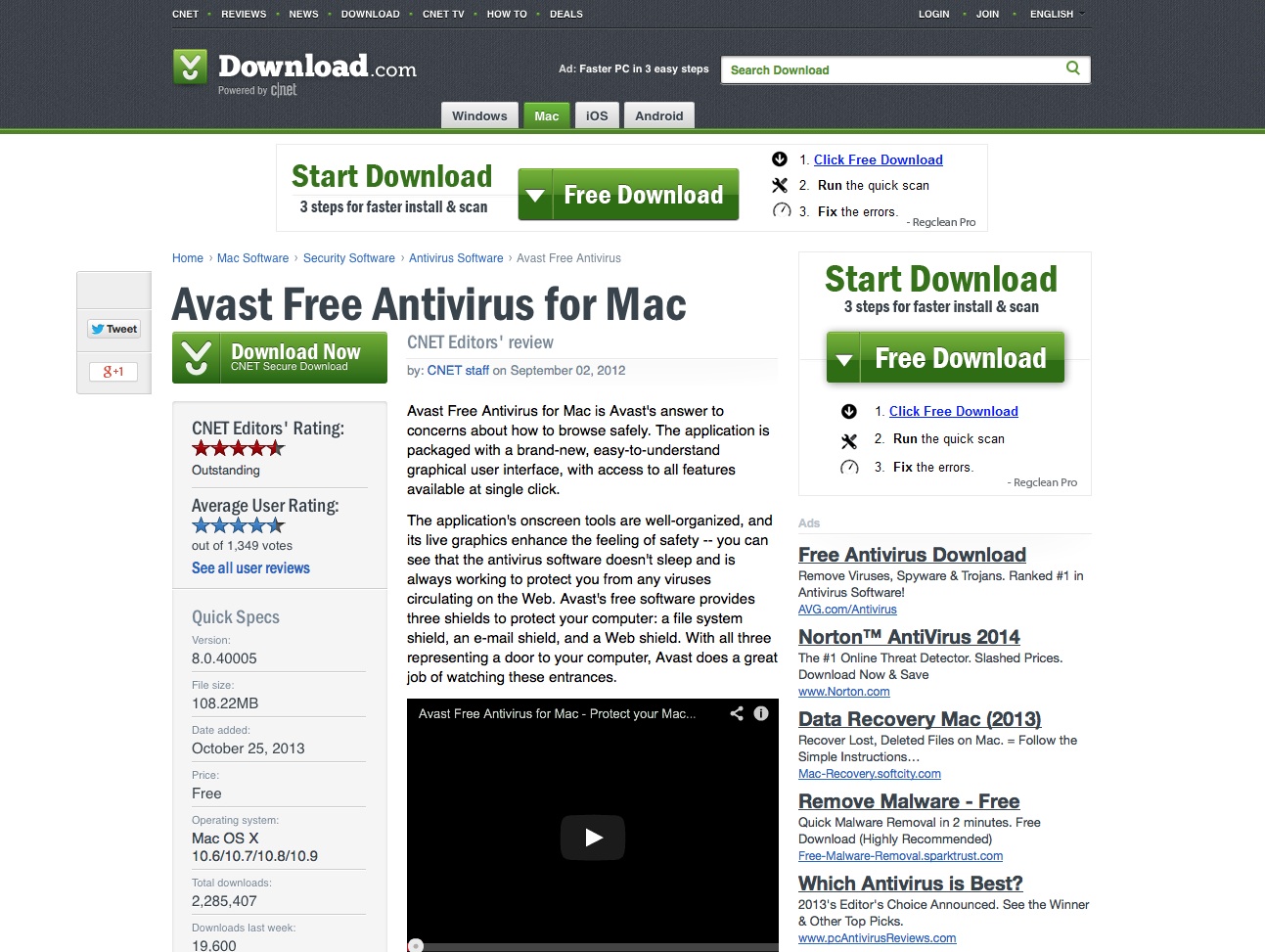
UPDATE: We originally reported about this on 5 February 2010. It’s been over 3 years and the problem persists. Indeed, it’s become worse. Here is a screen shot from Monday, 18 November 2013. You can see that the advertisers are now permitted to use download buttons that are almost indistinguishable from the legitimate non-advertising buttons. Click the image for a larger view.
[Below is the continuation of the article from 5 February 2010]
For example, when choosing to visit a download page such as the one shown here for AVG AntiVirus, the website visitor might be presented with a very large and glaring yellow button stating START DOWNLOAD. However, that button is part of an advertising banner for another product.
It’s understandable that many people would assume they should click that button to begin their download; unless they look further down the page and find the smaller blue text that says Download Now.

This is a common tactic of advertisers. Another misleading method is to include words in the advertisement such as, “Your computer is infected! Click here to repair.”
The management at cnet should not permit or allow such misleading ads on their download site. While the ads are good for the advertisers, and generate revenue for cnet, they mislead website visitors. Advertisers should stop using such misleading tactics to trick people.
Aside from the nuisance of downloading the wrong program, if the advertiser is not trustworthy, it would be possible for an advertisement to link to a malicious website or malware download (as recently happened with the New York Times website advertising).
Video. Below is a screen capture video showing this problem.
__________
Document History. This article was first posted on 20100215at1349. It was updated on 20131123sa0018 to include a recent screen shot. On 26 Jul 2024 the embedded video was updated for compatibility.